

Families pass down all kinds of things.
Eye color. Recipes. Inside jokes that make absolutely no sense to anyone else.
They can also pass down rules like:
We do not talk about feelings.
You must keep everyone happy.
If something could go wrong, worry about it until 2:00 a.m.
When you feel overwhelmed, shut down, blow up, get busy, check again, or disappear into something that gives you five minutes of relief.
The family recipe is usually easier to recognize.
This is where the idea of intergenerational trauma, sometimes called generational trauma, becomes useful. Not as a dramatic label for every imperfect childhood. Not as a way to put your parents on trial. And definitely not as proof that you are permanently damaged.
It is a way to understand why a survival pattern that made sense in one generation may still be running your life today.
What Is Intergenerational Trauma?
Intergenerational trauma refers to the ways unresolved fear, grief, shame, disconnection, and survival strategies can affect later generations.
Some of that transmission is obvious. Children watch how adults handle stress. They learn which emotions are welcome, which subjects are dangerous, who gets comforted, and who is expected to simply deal with it.
Some of it happens through attachment. If a parent learned that closeness was unsafe, that parent may love a child deeply and still become distant when emotions get intense.
Some of it is carried in family stories and silence. A family that survived persecution, poverty, addiction, violence, loss, immigration, or religious coercion may develop rules that once protected them. Stay quiet. Do not trust outsiders. Do not question. Keep moving. Never look weak.
Researchers have also explored biological stress pathways and possible epigenetic mechanisms.
That research is important, but it is complex and still developing. It should never be reduced to “trauma is written into your genes, so good luck.” Biology is not destiny.
The clearest place to begin is usually much simpler:
What happens in your family when somebody feels afraid, ashamed, angry, needy, uncertain, or out of control?
That answer often tells us more than a DNA test ever could.

The Pattern Usually Had a Job
Most unhealthy patterns did not begin because somebody woke up and chose dysfunction.
They began as protection.
Maybe staying hyperalert helped a parent survive a chaotic home. Maybe pleasing everyone kept conflict from exploding. Maybe emotional distance protected a grandparent who lived through unbearable loss. Maybe faith, work, food, porn, sex, achievement, or control became the only available way to regulate an overwhelmed nervous system.
Then the strategy outlived the emergency.
Years later, it may look like:
Constant scanning, overthinking, reassurance seeking, or worst-case planning
A couple trapped in the same pursue-withdraw cycle
Shame and secrecy around porn or compulsive sexual behavior
Feeling responsible for everyone else’s mood
Panic whenever someone is disappointed in you
Emotional numbness that looks like “I am fine” but feels like nothing
Religious or identity struggles where questions feel dangerous
A life organized around avoiding discomfort instead of living by your values
This does not mean that trauma causes every case of OCD, porn addiction, marital conflict, or anxiety. OCD in particular requires specific assessment and evidence-based treatment such as Exposure and Response Prevention (ERP). A family history can help us understand the emotional landscape, but it should not become a vague explanation for everything.
Insight matters. Precision matters too.
A Practical Map: Ground, Excavate, Integrate
Psychologist and intergenerational trauma expert Mariel Buqué, PhD, teaches a three-part healing framework: Ground, Excavate, Integrate.
That order matters.
You do not rip open the family history, stir up every painful memory, and hope healing somehow appears. First, you build enough steadiness to stay present. Then you look at the pattern. Finally, you practice a different way of living and relating.
1. Ground: Come Back to the Present
When an old alarm gets activated, your body often reacts before your thinking brain catches up.
Your jaw tightens. Your chest braces. Your voice gets faster. You feel an urgent need to explain, check, attack, escape, confess, fix, or numb.
Grounding is not pretending everything is fine. It is helping your nervous system recognize that this moment is not automatically the old moment.
Try this 60-second reset:
1. Put both feet on the floor and feel the chair supporting you.
2. Find three colors in the room.
3. Notice where your body is bracing, without forcing it to relax.
4. Ask, “What is happening right now, and what is my old alarm predicting?”
5. Choose one next action that fits your values, not your panic.
For someone with OCD, grounding must not become another ritual used to prove that you are safe or make uncertainty disappear. Notice the present, make room for the uncertainty, and continue with the
ERP response you are practicing.
The goal is not perfect calm.
The goal is enough presence to choose.
2. Excavate: Map the Pattern Without Holding a Trial
Once you can stay present, get curious.
Dr. Buqué’s intergenerational lens invites us to look beyond only “What happened to me?” We also ask what happened to the people who raised us and what was happening around the family.
Try this four-part family-pattern map:
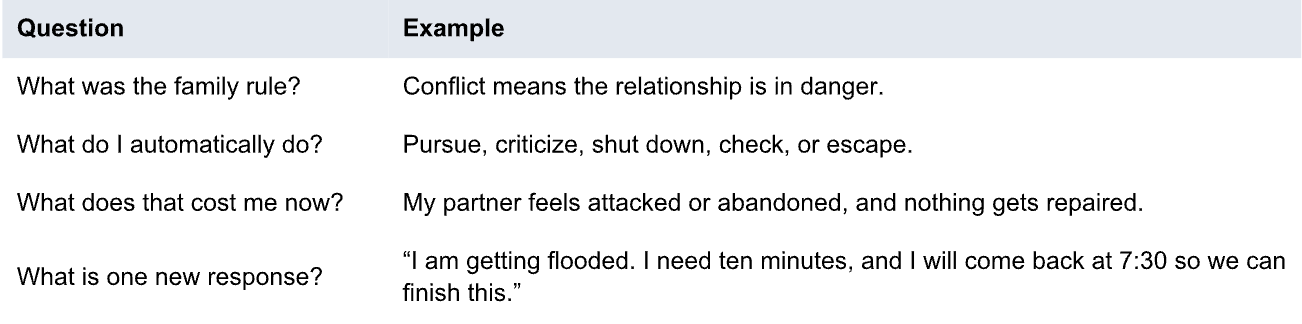
You can also ask:
Which emotions were allowed in my home?
What happened when someone made a mistake?
How did adults ask for comfort, if they asked at all?
What did my family do with anger, grief, sexuality, doubt, or shame?
Which survival rule am I still obeying even though the danger has changed?
Do not turn this into an endless investigation.
If you are researching your great-grandfather’s nervous system at 2:00 a.m. because you need the perfect explanation for your relationship anxiety, congratulations: the family map has become rumination.
Stop digging.
The point is not to solve your entire origin story. The point is to recognize the pattern early enough to do something different.
3. Integrate: Practice a New Ending
Understanding why you react a certain way can bring enormous relief.
It can also change absolutely nothing.
Integration means the insight begins to show up in your actual life:
In couples trauma therapy, you learn to recognize the old attachment alarm beneath criticism, withdrawal, defensiveness, or control. Then you practice naming what is actually happening and repairing instead of repeating.
In anxiety and OCD therapy, you stop treating every uncomfortable thought like a family emergency. You allow uncertainty and choose the next meaningful action without checking, confessing, researching, or seeking reassurance.
In porn and sex addiction therapy, you identify what the behavior is regulating without using that understanding as an excuse. Compassion explains the pattern. Accountability changes it.
In parenting, you repair after losing your temper. You name emotions without making your child responsible for yours. You show that love can survive frustration, disappointment, and an honest apology.
In spiritual and existential growth, you separate inherited fear from chosen faith, inherited expectations from chosen values, and a life of reaction from a life with meaning.
Healing becomes real when the next generation experiences something different from you, not merely when you understand why the old pattern existed.
Try This This Week: The 10 Percent Cycle Break
Do not try to heal seven generations by Thursday.
Pick one pattern and change it by 10 percent.
1. Name the inherited rule. “I must fix everyone’s feelings.”
2. Catch the trigger. Someone is disappointed with me.
3. Notice the automatic move. Explain, apologize repeatedly, or abandon my boundary.
4. Choose a 10 percent different response. “I hear that you are upset. I still need to keep this boundary.”
5. Repair when you miss it. No speeches. No self-destruction. Name what happened, own your part, and try again.
That is cycle-breaking.
Not perfection. Not becoming the calmest human being in Nevada. Not never getting triggered again.
It is noticing sooner, taking responsibility faster, and making the people you love less responsible for managing your alarm system.
Breaking the Cycle Is Not Blaming Your Parents
Two things can be true at the same time:
Your parents may have done the best they could with what they had.
And what they gave you may not be enough for the life and relationships you want now.
Compassion does not require denial. Accountability does not require cruelty.
You can understand the war, loss, poverty, family chaos, religious pressure, emotional neglect, or cultural realities that shaped the people before you. You can honor their resilience. You can love them.
And you can still say: This pattern stops with me.
That sentence is not a rejection of your family.
Sometimes it is the most loving contribution you will ever make to it.
When Intergenerational Trauma Therapy Can Help
Therapy may be useful when you can explain the pattern beautifully but still cannot interrupt it when your body gets activated.
Maybe you keep choosing unavailable people. Maybe the same argument takes over your marriage.
Maybe you live with constant guilt, checking, secrecy, emotional shutdown, or a fear of disappointing
everyone. Maybe you have worked hard to build a different life, but part of you is still living by an old family rule.
Good trauma therapy is not endless excavation. It helps you understand enough of the past to respond differently in the present.
I work with adults and couples in person in Las Vegas and through telehealth across Nevada. My approach is practical, relational, and specific, drawing from ERP, ACT, IFS, EFT, Gottman Method couples therapy, and trauma-informed work. We look at the pattern, but we do not live in the pattern forever.
Contact me if you are ready to understand what was handed to you, decide what you want to keep, and change what you do not want to hand forward.
Frequently Asked Questions About Intergenerational Trauma
What are common signs of intergenerational trauma?
Common signs can include repeated family patterns of emotional avoidance, hypervigilance, shame, people pleasing, explosive conflict, difficulty trusting, secrecy, or trouble tolerating uncertainty. None of these automatically proves trauma. The useful question is whether the pattern repeatedly harms your functioning, relationships, or ability to live by your values.
Can intergenerational trauma cause OCD?
There is no simple “your family trauma caused your OCD” explanation. Family stress and learned coping may shape how someone experiences anxiety or which themes feel especially charged, but OCD is a distinct condition that requires appropriate assessment. ERP is the first-line behavioral treatment and should not be replaced by family-history exploration.
Can couples therapy help break generational patterns?
Yes. Couples often replay familiar attachment strategies without realizing it. One partner pursues harder, the other withdraws further, and both feel increasingly unsafe. EFT, Gottman Method work, and trauma-informed couples therapy can help partners see the cycle, slow it down, and practice a more secure response.
Does breaking the cycle mean cutting off my family?
No. Some people need stronger boundaries or distance, especially when harm is ongoing. Others break cycles while remaining close to their families. The goal is not a predetermined relationship decision. The goal is greater safety, honesty, responsibility, and freedom of choice.
How long does healing generational trauma take?
There is no honest universal timeline. Some patterns shift quickly once they are named and practiced differently. Others are deeply reinforced and take longer. Progress usually looks less like “I never react” and more like “I notice sooner, recover faster, repair better, and choose more freely.”
Credit and Further Reading
This article was inspired in particular by Mariel Buqué, PhD’s 2023 PESI Kids training, Break the Cycle of Intergenerational Trauma: Comprehensive Assessment, Tailored Interventions, and Empowered Understanding. Her Ground, Excavate, Integrate framework provides the central map used here. Dr. Buqué develops her approach more fully in “Break the Cycle: A Guide to Healing Intergenerational Trauma”.
For a careful discussion of the emerging and still-contested science of epigenetic pathways, see Amy Lehrner and Rachel Yehuda’s review, “Cultural Trauma and Epigenetic Inheritance”. The application to ERP, ACT, IFS, EFT, Gottman Method work, compulsive sexual behavior, couples therapy, and the practical exercises in this post reflects my own clinical integration and wording.