

Most people try to stop porn or compulsive sexual behavior at the worst possible moment: when the urge is already strong, the phone is in hand, privacy is available, and the mind is focused on immediate relief. If they act on the urge, they often conclude that they simply lack self-control.
That conclusion is usually too simple. The final click, search, message, or sexual behavior is the end of a longer chain. Effective recovery is less about winning one dramatic battle and more about understanding where that chain begins, where it tends to break down, and what you can change before the urge reaches full intensity.
That is the approach I use in porn and sex addiction therapy: understand the pattern, restore choice, and build a plan that works both before and during the urge.
A Five-Part Model for Understanding Sexual Urges
Hofmann and Kotabe's self-control model is useful because it breaks a vague problem such as "I keep doing this even though I do not want to" into specific places where change can happen. For porn use, compulsive masturbation, sexual messaging, hookups, or other sexual behavior that no longer feels chosen, I find five checkpoints especially practical: desire, conflict, motivation, volition, and opportunity constraints.
The model also separates prevention from intervention. Prevention is what you do before an urge becomes strong. Intervention is what you do once the urge is already active. Both matter, but prevention usually gives you more room to think and choose.
1. Desire: What Is the Urge Trying to Do for You?
The first question is not "How do I become stronger?" It is "What is creating the pull?" Sometimes the answer is ordinary sexual desire. A strong libido is not automatically a problem. The concern is when a particular behavior becomes repetitive, difficult to control, or disconnected from the life and relationships you want.
For many people, the urge is also doing emotional work. Porn or sexual stimulation may offer fast relief from boredom, loneliness, anxiety, rejection, anger, shame, exhaustion, or emotional numbness. If you only fight the behavior and never understand the state that precedes it, you can spend years arguing with the last step of the cycle.
This is where IFS therapy for porn and sex addiction can be useful. Instead of treating the urge as an enemy, we get curious about the part of you seeking relief, stimulation, comfort, or escape and then work with the need underneath the behavior.
2. Conflict: Keep the Life You Want in the Room
An urge becomes a self-control problem when it conflicts with something else that matters to you. You may want immediate stimulation and also want honesty, better sleep, a stronger relationship, more focus, financial stability, or the ability to trust yourself. In the heat of an urge, that larger goal can temporarily disappear from view.
This is why "just this once" is so powerful. The mind narrows the frame to the next few minutes and quietly removes tomorrow, your partner, your values, and your longer-term plans from the decision. One practical goal of recovery is to bring the full choice back into view before you act.
The skills I use in Acceptance and Commitment Therapy (ACT) fit naturally here. ACT teaches you to notice an urge and the thoughts around it without treating either one as a command, then reconnect with the values that matter in the next action.
3. Motivation: Why Do You Actually Want to Change?
Knowing that a behavior causes problems is not the same as feeling motivated to resist it at 11:30 p.m. Motivation changes with stress, fatigue, loneliness, conflict, alcohol, travel, and mood. A plan that depends on feeling equally committed every hour of the day is fragile.
Make the reason for change specific. What do you want back: trust, intimacy, sleep, concentration, integrity, confidence, time, or freedom from secrecy? A clear reason does not guarantee perfect choices, but it gives self-control something meaningful to protect.
For some people this becomes part of broader existential therapy and growth work. Recovery is not only about what you want to stop doing. It can also be about the kind of person you want to become and the kind of life you want your choices to support.
4. Volition: Decide What You Will Do in the First Ten Minutes
This is the part most people call willpower. The urge is here, you recognize the conflict, and you want to make a different choice. At that point, "be strong" is not a plan. You need a short sequence that your body can actually carry out while you are activated.
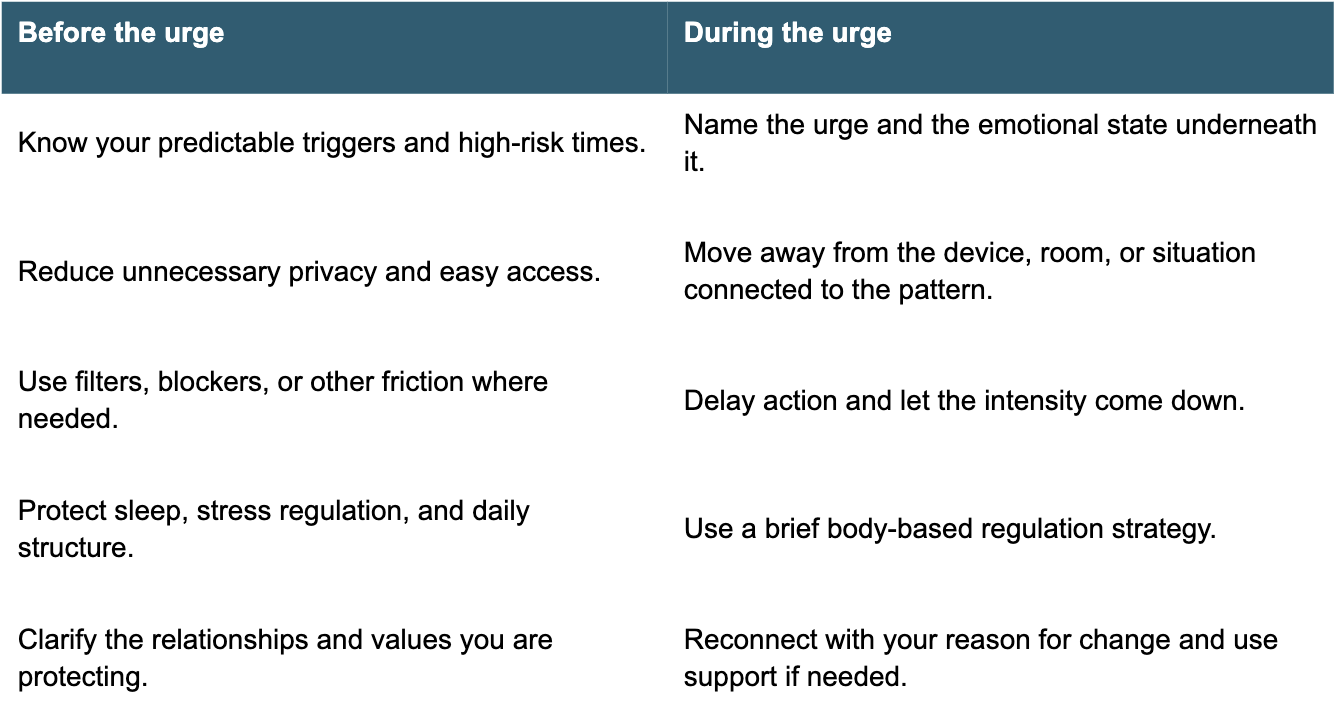
Name what is happening: "I am having a strong urge and my brain wants quick relief."
Change the physical situation. Put down the device, stand up, leave the room, or move into a less private space.
Delay the decision for ten minutes. The goal is not to promise how you will feel later. It is to avoid acting at the peak of the current wave.
Regulate your body. Walk, shower, stretch, breathe slowly, or do something brief that reduces activation rather than feeding it.
Reconnect with the reason you chose to change and use support or accountability if the urge is still climbing.
The purpose is not to force the urge to disappear. It is to create enough space between urge and action for choice to return.
5. Opportunity Constraints: Make the Behavior Less Automatic
If the behavior is available instantly, privately, and with almost no friction, you are asking yourself to make the same difficult decision repeatedly under the worst conditions. Changing the environment is not cheating. It is part of self-control.
Useful opportunity constraints can include keeping the phone out of the bedroom, removing saved content or hidden accounts, using website blockers, having someone else control a filter password, moving computer use into a shared space, or changing routines during predictable high-risk times. A barrier does not have to be impossible to bypass to be useful. Even a small pause can interrupt automatic behavior long enough for the rest of your mind to come back online.
If porn use has become tied to secrecy or relationship injury, I discuss that more directly in When Secrets Spill: Porn Addiction, Secrecy, and the Cost to Marriage.
Prevention Is Usually Easier Than Fighting a Full-Strength Urge
One of the most useful parts of the model is the distinction between preventive and in-the-moment self-control. If your pattern usually happens late at night, after relationship conflict, during travel, when you are alone, or after long stretches of unstructured scrolling, those details are not incidental. They are part of the treatment plan.
The goal is not to organize your whole life around avoiding sexuality. It is to stop repeatedly placing yourself in the exact conditions where the compulsive pattern is strongest and then expecting a different result without changing anything around it.
A Simple Porn and Sexual Urge Plan
If You Slip, Study the Chain Instead of Giving Up
A lapse can quickly become a second problem when the person concludes that the whole recovery effort was fake or pointless. A more useful response is a brief chain analysis. Where did the process break down: unusually strong desire, loss of contact with your goals, low motivation, no executable response plan, or easy access?
The purpose is not to minimize responsibility. It is to make the next response more intelligent. Shame tends to collapse the entire event into "I am the problem." Treatment asks a more useful question: "What happened in the sequence, and what do I need to change before the next high-risk moment?"
High Sex Drive and Compulsive Sexual Behavior Are Not the Same Thing
A high libido by itself is not an addiction. The clinically important questions are whether the behavior feels difficult to control, whether it is being used in ways you do not want, and whether it is causing meaningful problems in relationships, work, health, finances, or daily life. Frequency alone does not answer those questions.
If your concern is actually the opposite, meaning low desire or difficulty getting interested in sex, see the companion article How to Get Your Sex Drive Back: Desire, Arousal, and Intimacy. Designer: activate this link once that article is live.
Planned Intimacy Can Be More Helpful Than Waiting
Some couples dislike the idea of scheduling intimacy because they associate good sex with spontaneity. In long-term relationships, however, waiting for both partners to feel spontaneous desire at the same moment can leave very little space for sexual connection. Planning time together is not the same as promising intercourse. It simply protects time in which closeness and arousal have an opportunity to develop.
A planned intimate evening might include conversation, showering, massage, kissing, affectionate touch, or sexual activity if both people want it. The important distinction is that the time is intentional while the outcome remains voluntary. That can be especially helpful when one partner experiences responsive desire and rarely begins the evening already wanting sex.
Frequently Asked Questions About Porn, Sexual Urges, and Self-Control
How do I control sexual urges when they feel overwhelming?
Start earlier than the final decision. Identify what tends to trigger the urge, reduce easy access, and decide in advance what you will do during the first ten minutes. When the urge is active, change the environment, delay action, regulate your body, and reconnect with the reason you chose to change.
How do I stop watching porn when I keep going back to it?
Treat the relapse as information about the system, not proof that you are incapable of change. Ask which checkpoint keeps failing: desire, awareness of consequences, motivation, your in-the-moment plan, or access. Then strengthen that part of the plan instead of making a broader promise to "try harder."
Is a strong sexual urge the same as sex addiction?
No. Strong sexual desire is not automatically pathological. Concern rises when sexual behavior repeatedly feels difficult to control and is creating distress, secrecy, impairment, or consequences in important areas of life.
Do porn blockers and filters really help?
They can. Their job is not to cure the underlying pattern. Their job is to add friction and create a pause between an urge and the behavior. That pause can be clinically useful, especially when access has become automatic.
Can ACT help with porn or compulsive sexual urges?
ACT can be useful when a person treats an urge as something that must either be obeyed or eliminated. ACT helps you notice the urge, allow the internal discomfort to be present, and choose behavior based on your values rather than on the intensity of the moment.
When should I consider professional help?
Consider therapy when you have repeatedly tried to change and cannot sustain it, the behavior is escalating, secrecy is damaging a relationship, sexual behavior is interfering with work or daily functioning, or porn and sex have become a primary way of regulating distress.
Regaining Control Means Building Choice Earlier
The most important shift is to stop treating self-control as one dramatic decision at the end of an urge. Control is built earlier: when you understand what activates desire, keep your larger goals available, strengthen motivation, know exactly what to do during the first few minutes, and shape your environment so that a difficult moment does not have unlimited access to the easiest outlet.
That approach is more respectful than treating sexual desire itself as the enemy. Sexuality does not have to disappear for you to decide that a particular pattern no longer belongs in your life. The goal is greater agency: more room between wanting something and automatically doing it, and more ability to choose a sexual life that fits your relationships, values, and sense of self.
Porn and Sex Addiction Therapy in Las Vegas and Throughout Nevada
If porn, compulsive masturbation, sexual urges, secrecy, or other sexual behavior feels increasingly difficult to control, I offer porn and sex addiction therapy in Las Vegas and telehealth throughout Nevada. Treatment can integrate IFS, ACT, somatic work, and values-focused therapy depending on what is maintaining the pattern.
If you want to talk about what is happening and what treatment might look like, contact Avi Anderson Therapy.